This song has biblical references to the miraculous conception of Isaac by Sarah. In Genesis 17-20 Abraham converses with God and God promises to him that albeit her old age Sarah will have a son and God will make his covenant with him. We tend to forget that before the birth of Christ, God has this strange habit of bringing children to baren women in the Old Testament.
This song, as many other folk songs, has several versions of the core text. Although folk songs have rather high fidelity of transmission, it is interesting to see that key esoteric knowledge may exist in different versions as well.
Version 1:
Аврам Зорица думаше:
– Зорице, ясногрейнице, Зорице, мила сестрице.
В моите двори не грееш, не ми булчето преспиваш, не ми децата разплакваш.
Ганка по двори ходеше и се на Бога молеше:
– Я дай ми, Боже, харижи. Едничка рожба от сърце, не щем го, Боже, за много, да рече мама и тати.
Avraam is speaking to Zoritsa:
– Dawn, bright shining one, Dawn, my sister,
You are not shining in my yard, you are not putting my bride to sleep, you are not making my children cry.
Ganka was walking in the yard and praying to God:
– Please, God, make me a gift! The gift of a child from the heart. God, I don’t want much of him – only to utter “mother” and “father”.
Version 2:
Аврам Зорници думаше:
– Зорнице, ясногрейнице, Зорнице, ранобуднице
Tи като рано огряваш, младите булки приспиваш, старите баби събуждаш, дребните деца разплакваш,
A мене, мари Зоро льо няма кой да ме събуди.
Язе си нямам, Зоро льо, едничка рожба от сърце – “мама” и “тате” да каже.
Avraam was speaking to Zornitsa: Morning Star, bright shining one, Morning Star, first one to rise,
When you shine early the morning, you are putting young brides to sleep, you are waking up the old grandmas and you are making the small children cry.
But me, dear Dawn, there is no one to wake me up!
Dawn, I have no child from the heart – to utter “mama” and “father”.
In Revelation 22:16 Jesus says, “I, Jesus, have sent my angel to give you this testimony for the churches. I am the Root and the Offspring of David, and the bright Morning Star.”
In 2 Peter 1:19-21 “We also have the prophetic message as something completely reliable, and you will do well to pay attention to it, as to a light shining in a dark place, until the day dawns and the morning star rises in your hearts.”
The Biblical passage of Isaac miraculous birth has been taken in the oral Balkan tradition and fused with previous beliefs in a rather particular way, which shows the author knew how to match a biblical miracle with a corresponding local myth and correctly “sew” both at the right places.
Morning Star and Dawn
Since the tradition is oral, the very close words Zoritsa (from Zora – Dawn) and Zornitsa (Morning Star) seem to be interchangeable in different versions of the song. Zorya is a Slavic goddess of the dawn, which opens the gates for the Sun in its double form – morning and evening dawn. The Slavic word zora “dawn, aurora” (from Proto-Slavic *zořà), and its variants, comes from the same root as the Slavic word zrěti (“to see, observe”, from PS *zьrěti), which originally may have meant “shine”. Zornitsa is still used even nowadays to signify the Morning Star.
It would be impossible not to notice a certain ancient clin-d’oeil and nod to other biblical texts related to the Morning Star and Dawn. The author of the song purposefully extracted and blended them.
- The first reference to the morning star as an individual is in Isaiah 14:12: “How you have fallen from heaven, O morning star, son of the dawn! You have been cast down to the earth, you who once laid low the nations!” (NIV).
- In Revelation 22:16 Jesus says, “I, Jesus, have sent my angel to give you this testimony for the churches. I am the Root and the Offspring of David, and the bright Morning Star.”
- In 2 Peter 1:19-21 “We also have the prophetic message as something completely reliable, and you will do well to pay attention to it, as to a light shining in a dark place, until the day dawns and the morning star rises in your hearts.”
- In Revelation 2:28 “And I will give him the morning star.”
The different versions of the song diverge about the effect of Zora on the house inhabitants. Common verses are that Zora doesn’t shine in Avraam’s house at that moment and that he (or Ganka / Sarah) is childless.
The dark yard
The dark yard is the crucible of the taoists. It’s dark and empty and can’t produce the immortal child (child of the heart) unless the star appears. The star that brings forth the sun and moon.
The Sleeping Avraam
The sleeping Avraam is the main character. His words are uttered in sleep. Notice that the Dawn / Morning Star regulates sleep in this this song. It regulates the sleep of the tripple feminine – bride, grandma and child, but it can’t by itself awaken Avraam. In the first version of the song we find Ganka pleading God, and not the Morning Star, for a child. Notice that Ganka is walking in the dark yard where the Morning Star is not shining.
The child from the heart
The waking up of Avraam / the plea of Ganka is tightly connected to having a child from the heart. It must be noted here that the expression itself “дете от сърце” is slightly ambiguous. It does translate directly as child from the heart, but in colloquial usage it could mean a child close to heart, a gift from heart.
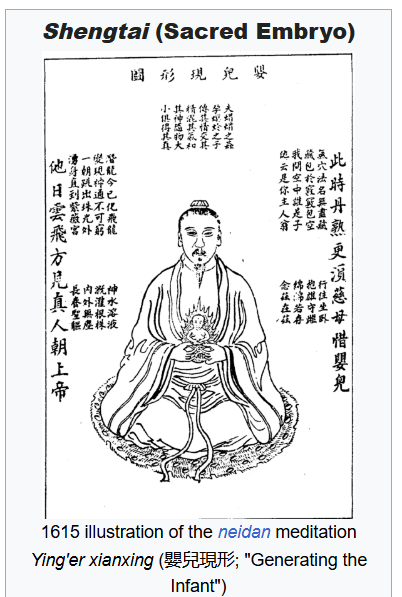
This is the immortal child. The immortal child is referenced in other songs as well. Daoist Internal Alchemy practitioners developed the term shengtai “sacred embryo” into a complex process of symbolic pregnancy generating a spiritually perfected duplicate of oneself within oneself, which later became synonymous with the elixir of immortality in External Alchemy. This alchemical embryo “represents a new life, true and eternal in its quality”. In Internal Alchemy, the “sagely embryo” is an amalgam of Buddhist ideas concerning latent spiritual qualities that are developable through a symbolic birth leading to awakening, and Daoist ideas of accessing immortality through fan (反; “reversion”) to the cosmic matrix. (source: Wikipedia). The eastern tradition underlines that the exit of the embryo is through the crown of the head.
To this I would add a few other quotes:
“The radiant one inside me has never said a word. God, take my soul to that place where I may speak without words.” (Rumi)
“And because you are sons, God sent forth the Spirit of His Son into our hearts, crying out, “Abba, Father!” (Galatians 4:6)
Masterful performance of the song in 2021 and 1957. The first version is slightly modernized, but still quite close to the original folk song, which itself carries already some of the “polished style” of the 50s.
 Taina voda
Leave a comment