A few years ago, before the emergence of ChatGPT, I entered (foolishly) into an online debate with someone over the topic of creativity. My online adversary considered that creativity is what sets a human apart from the animal kingdom and therefore it is divine by origin. Creativity, he said, was the way the soul expresses itself and no one can take away that from a human. True freedom lies in creativity. Because nothing compares to the power of the human mind…
Does it?
There is nothing really sacred in creativity or human intelligence for that matter. Tools based on LLMs have showed us that very good part of creativity is actually mechanical in nature. In its current state a very basic level of creativity and human intelligence is just overpaid work that begs to be flattened all the way down to a few lines of code and a monthly subscription. But why does this happen? Why the pride of the Enlightenment – the ability of a human to reason and produce God-like work based on its intellectual capacities, has suddenly become at least partially somewhat outsourceable ?
Why we dethroned a God with the might of our intellectual capacity, only to end up making fantasies about superintelligence that will take over the control?
Let’s take a few steps back.
Today we live in a world where science has dethroned religion in the miracle making business. Again, thanks to the same guys of the Enlightenment age. Science marvels today and playfully allows some space for the existence of God when catching attention means more funding (ex. all online content on quantum computing in the last 10years. When the concept must be vulgarised for the masses, somehow we all need to see the “overseeing eye” in the double slit experiment. No shame, guys!). The miracle making business has longtime thrived on two things – basic science and ignorance. And up until a few centuries ago, only spiritual leaders knew how to masterfully use the two to obtain the favor of the kings. “Religion is opium for the masses” said Karl Marx, but he was as adamant about who who needed to sell this drug to the masses – the kings! Nowadays, specialisation has determined that science, entertainment, media and algorithms can do what was previously the job of the village shaman – control the masses.
Technology pushed away the fear from the divine. Each invention was one step further, which reclaimed more footing for the human, less for the obscure world. Some inventions are more interesting than others:
- The invention of fire (1M years ago) is the first transfer of power from the hostile nature to the human. The myth of Prometheus tells us that humans really experienced it as a hack to the matrix – a wrongly given gift, a stolen knowledge punishable by the gods, but irreversible. Technology created significant and permanent power transfer.
- The invention of art such as painting, poetry, music, plastic arts, textiles, weaving and finally writing sytems materialised our thoughts and emotions in a form that can last for centuries after us. We found technology to give body and permanence to the most impermanent matter – our thoughts.
- Building is a complex story by itself as it mixes several arts and spiritual aims. But with the creation of the first tools (3,3M years ago ) and building and irrigation we set forth to remodel the physical world that surrounds us to match better our needs. Like this planet has never produced a single place comfortable enough for a human to survive in his/her natural state.
- Horse domestication taught humanity that anything alive and less intelligent, but more capable than us can augment our capacity to do. Harnessing the power of the animal is a recurring theme in spiritual art, but in simple terms we augmented the insufficiency of our legs and arms. It is precisely the horse power that made the conquest of the world possible. And we continued replacing our muscles for centuries afterwards. But also this event imprinted in us that only lesser intelligence is controllable.
- Agriculture (12 to 15 000 years ago) was a game changer for humanity. It replaced freely given nutrient dense food with labour toiled nutrient lacking bread. Remember that God preferred Abel’s game over Cain’s grains ? Cain won though. Again, the human forced its choice over God’s one. The agricultural myth is probably the most long lasting one in spiritual traditions and beyond the powerful truths hidden in it, it has had the worst impact on women and the female path. It’s also the reason you see some female sects not consuming grains. Agriculture has also stopped human evolution.
- Work with metals such as iron (1200 BCE) has been probably the last invention of major impact and interestingly it has not been backed by major religious shift, but by esoteric streams such as alchemy. It’s very close as meaning to cooking.
These are the major technological milestones of immense impact on humanity. We have basically built our world based on these mostly neolithic inventions. They all have been intertwined with powerful spiritual myths. Or the correspondence of the technology to a spiritual truth has been paramount. Even today’s major religions trace their origins to agricultural myths. Then as we usher in the Christ era a slow but sure drift happens between minor inventions (sailing, windmill, compass, clocks, etc.) and religion. We see the divorce being played out best in Europe. But still inventions continue to happen:
- During the Industrial revolution we learned that we can use machines to automate manual labor. Inventions such as the steam engine (1765) and railways (1804) made possible that things “moved by themselves” on our orders and needs. Photography (1826) captured our image creating fear among the first users that it will capture their soul. Christianity was naturally uncapable of accompanying this avalanche of events.
- The invention of the telegraph (1844), telephone (1876) and radio (1901) transported our voices as ghosts over long distances. We needed to defy limitations of space to produce miracles with our voices.
- The electric light (1879) finally pushed the darkness away.
- The advent of computers in the 20th century has slowly started to replace intellectual functions such as calculation. This is the start of the question if our brain activity can be outsourced and replaced just as we have done with our muscles.
Note that this second wave of inventions has nothing to do with any religious movement, but holds its own brand name – science.
In short we fought our imperfection in any possible way. Being so unfit for this world and driven by desire for survival we became masters. And it must be because our intelligence is synonym of higher power:
- God created this world, I am created in his image, so I can create too and every act of my creation is as divine as his => my intelligence is a gift from God.
- Or I can challenge God – he is not the sole creator, as I can do this on my own and proove his inexistence or incapacity to interfere => God doesn’t exist, my intelligence is glorious.
In any of these cases the act of coming up with the creation in humans is mechanical, automatic and lacking true consciousness. What is divine is the need to defy this world. Christ says “You are in this world, but not of this world” (John 17:16). And it is this unfitness with this world that transpires in our acts. That’s why God names his people Israel “The One who Struggles with God”. Unfitness comes from uneasiness, which comes from defying sleep. Christianity links this unfitness to sin, which must be irradicated. If you conquer sin, you will restore your state of divinity. Modern science capitalises on this unfitness by proclaiming its greatness in miracle making without ever addressing the source or reason behind it.
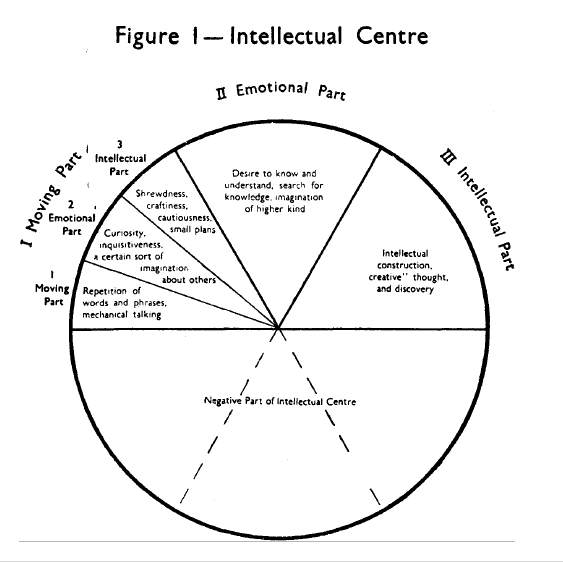
The best source on why creativity is a mechanical activity way before LLMs starting to produce the first clumsy images based on a simple text prompt, belongs to Gurdjief. In the first half of the 20th century he teaches that the sorry human condition is caused by the poorly regulated functioning of three psychological centers: moving (sex, instinctive and motor), emotional and intellectual. These centers are not you, neither your soul. They exist in human consciousness and subconsciousness as major drivers of psychological sleep. They represent different aspects of our animal nature that hinder us and must be properly regulated. The intellectual center is the one that produces creativity through its proper intellectual function and the moving sub-center, which produces even more mechanical and repetitive creativity. Even curiosity stems from this moving part. You can learn more about the functioning of the centers by reading Ouspenski, Maurice Nicoll or Gurdjieff himself.
In any case Gurdjieff is the only author to my knowledge who has treated creativity specifically as non related to the soul. Many other religions will simply consider that thoughts themselves must be stopped for higher knowledge or that creativity is simply a gift of God or Satan (at worst).
So what?
All major inventions from the dawn of humanity all the way up to the advent of agriculture have been augmenting our body or modifying the environment to our advantage. We have kind of reached the limits of this. Any function of us that was found lacking, was outsourced to a better technology. The 20th century marks a new wave – augmenting intellectual functions. But without a proper understanding of the human psychological makeup. You see today it’s clear that there is not much value added in certain activities of knowledge work, but what we fail to see from spiritual perspective is that this augmentation of the intellect is a living proof of how mechanical is the human mind. A tangible proof no one was able to give until today.
We can replace only that, which is not human in us. Any expression of our animal nature is to be questioned and corrected when found lacking, even the most cherished of them all – our ability to reason and create. Inventiveness is an inner journey to the real human. Any layer of our intellect can finally now become disectable and outsoursable. Religion tells us that with our intellect we cannot reach God and there is a reason for this.
Because “as above, so below”.
 Taina voda
Leave a comment